The A D Cunliffe Cylinder Musical Box Register
This register of cylinder musical boxes has been compiled by its originator, Arthur Cunliffe, over a period of more than 40 years, and contains details of over 15,000 individual cylinder musical boxes.
These details include, where known, the make, type, date, serial and gamme numbers, musical repertoire, dimensions and descriptions of the boxes and additional notes of any unusual features.
Maintained by the Registrar of The Musical Box Society of Great Britain, it is a unique record of data, and is not only an invaluable research tool, but can assist with reporting and recovering stolen property. From the information held it is often possible to determine the date, make and place of manufacture of a box if this is otherwise unknown, and to identify the tunes where a tune sheet is lacking.
Researchers with a query for the register should contact the Registrar.
Registration is anonymous and no record is kept of the person owning/registering a box.
To register a box and obtain its unique identifying registration number send a completed form to:
The Registrar
The Musical Box Society of Great Britain
Aeolian Court
Station Hill
Chudleigh
Newton Abbot
Devon
TQ13 0EE
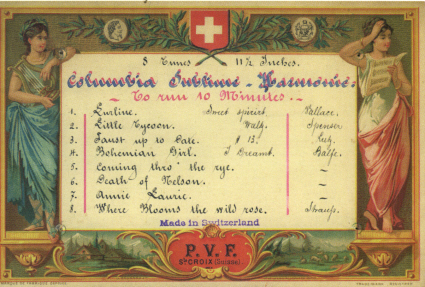
Cylinder Musical Box Tune Sheets
Tune sheet images and annotations, compiled and edited by the late Anthony Bulleid and Tim Reed, are available on-line, consisting of the original book and four supplements.
Includes Maker Index and Dating Charts and the Search Engine devised and compiled by the late Luuk Goldhoorn.
Hard copies of ‘The Cylinder Musical Box Tune Sheets’ and its supplements may be available upon request
Tune lists
The Society aims to produce comprehensive tune lists for all types of mechanical musical instruments. The lists have been created from original catalogues and from details sent in by members and other collectors.
MBSGB Archive
The Musical Box Society of Great Britain holds an archive of material relating to all aspects of Mechanical Music. A valuable research source it includes:
- A comprehensive library of books, mostly in English, but a few non-English, many now out of print.
- An extensive collection of publications from other mechanical music societies around the world.
- Copies of press cuttings, tune lists, auction catalogues, catalogues and leaflets for museums and collections, documents and ephemera.
- A selection of material on audio, visual and digital media.
- Items from the personal archives of Arthur Ord-Hume, Graham Webb, Keith Harding, Anthony Bulleid and Robin Timms.
Material is not normally loaned out, but may be inspected by appointment.
Enquiries should be addressed to: archivist@mbsgb.org.uk
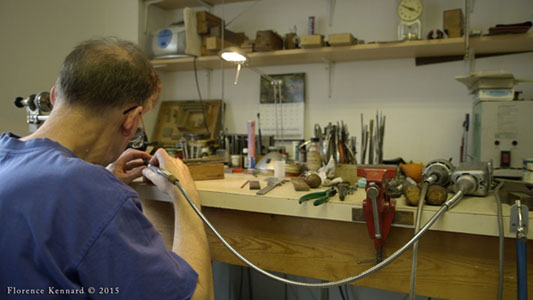
Musical Box Repair and Restoration
We receive a lot of requests for advice on repair or restoration projects. Much irreparable damage can be caused to a musical box or other mechanical instrument by well-meaning but inexperienced amateurs, even with an engineering background, often rendering the piece unplayable and valueless. If you are tempted to embark on a repair project, please seek advice beforehand.
We can advise you as to what is safe to tackle and what is better left to the experts.
Where appropriate, we can put you in touch with someone who can mentor you through a project, or suggest a ‘professional’ better qualified to carry out the work on your behalf. No amount of information on the internet or in books can compete with personal experience or specialist training! Please don’t risk destroying for ever an historic item.
Useful Links
View our useful links for contact details of restorers and suppliers for musical boxes and other instruments.
FAQ's
Do you need to own a mechanical instrument in order to become a member?
No. In fact, membership give you the opportunity to enjoy other people’s. If you are
thinking of acquiring something, by joining you will learn more about what to look out for and
where to find one.
Is this a ‘hurdy-gurdy’/ what is a ‘hurdy-gurdy’?
The term ‘hurdy-gurdy’ is used as another name for a specific instrument whose proper
name is a ‘vielle a roue’, the origins of which go back to the Middle Ages. Strictly speaking,
it is not a self-playing instrument, only the bowing action is automatic, the rest of the musical
production is manual. Over the years the term ‘hurdy-gurdy’ got erroneously applied to other
musical instruments with a self-playing action, in particular to small street organs or
organettes. They are not hurdy-gurdies, nor are musical boxes.
How much is my instrument worth?
It is not possible to give a value generally to an instrument, as each instrument is different
and it will depend on what it is, what condition it is in, what quality it is, and what the demand
for such an item is. Over recent years the value of mechanical instruments has polarised
considerably with the majority of instruments falling in value, whilst the ‘high end’ have
increased in value substantially. If you need a valuation for insurance purposes, probate or
because you are thinking of selling, contact a specialist in the field (see our ‘Useful links’
page). Note that this is a service, and you may well have to pay a fee, so ask how much it
will cost to have a valuation.
I have a musical box/ organette/organ which I think needs some attention. How can I restore it?
A: We never recommend the amateur taking on repair work of any kind unless they have
exceptional specialist knowledge and experience. It is very easy for a well-intentioned
amateur to ruin a beautiful item, and many have been damaged or destroyed in this way
over the years.
We recommend you contact one or more of the restorers on our website for
further information or at the very least, join the Society and be put in touch with competent
‘amateurs’ who will advise and/or mentor you.
A professional restoration may well cost more than the value of the restored item, so
consider whether you can ‘put a price’ on the pleasure you will ultimately derive, or whether
it would be better to sell it as it is to someone who will know how/want to restore it for
themselves.
Watch and clock repairers do not always have the extra-specialised knowledge needed to
execute a good musical box restoration, so we advise contacting one of the specialists listed
on our site.
Are these things rare?/Where can I get one?
Depending on what the enquiry is about, it may be rare, but many mechanical instruments
are currently more available than you might think, and cost a relatively modest amount. If
you are interested in acquiring one, join the Society and network to find out if anyone is
disposing of what you would like; also ask the sellers listed on our website.
Where can I find out more about an instrument?
There are several books on the topic written over the last 80 or so years (see our
recommended reading list). Also, join the Society, meet the ‘experts’ and get invited to see
and hear private collections.
How can I find out the date of my instrument?
Send your specific enquiry with details to info@mbsgb.org.uk
How can I find out the tunes on my musical box?
If you can identify the maker and/or have a serial number and can supply other details, we
may be able to identify them. Send your query to info@mbsgb.org.uk
How do these things work?
That depends on what the instrument is. All self-playing instruments will have some sort
of musical programme, whether it is a pinned barrel of a barrel organ, a perforated paper roll
for an organette or player piano, a pinned cylinder or perforated disc for a musical box, and
so on. Musical boxes work on the clockwork principle, that is, the energy released by a
wound metal spring; some instruments are powered by weights, some, ‘newer’ ones by
electric motors. Some organs and all organettes are ‘powered’ by the operator manually
turning a handle. Read more on our ‘About mechanical music’ page, and join the Society to
find out more.
READING LIST
This reading list brings together key reference works on musical boxes and self-playing instruments, offering a foundation for understanding their history, construction, and preservation.
- Automatic Organs by A.W.J.G. Ord-Hume
Several of the books by Arthur W J G Ord-Hume overlap in content – you may find one on musical boxes, for example, suffices, and if you cannot find a specific one, look for an alternative.
- Automatic Pianos by Arthur W.J.G. Ord-Hume
- Barrel Organ by Arthur W.J.G. Ord-Hume
- Church & Chamber Barrel Organs by Langwill & Boston
- Clockwork Music by A.Ord-Hume
- Collecting Musical Boxes & How to Repair Them by A.W.J.G.Ord-Hume
- Cylinder Musical Box Design & Repair by H.A.V.Bullied
- Cylinder Musical Box Handbook, The by Graham Webb Faber
- Cylinder Musical Box Technology by H.A.V.Bulleid
- Disc Musical Box Book, The by Kevin McElhone
- Disc Musical Box Handbook, The by Graham Webb
- Encyclopedia of Automatic Musical Instruments by Q.David Bowers
- Encyclopedia of Disc Music Boxes by Q David Bowers AMICA
- Fair Organ and How it Works, The by Eric V Cockayne
- Fairground Organ: its Music, Mechnanism and History, The by Eric V Cockayne
- Figures in the Fourth Dimension by Ellen S Rixford (musical automata)
- Introduction to Mechanical Music, published by AMBC
- Mechanical Music by Kevin McElhone
- Singing-Bird Tabatieres by Geoffrey T.Mason
- Mechanics of Mechanical Music, The by A W J G Ord-Hume
- Musical Box by A W J G Ord-Hume
- Musical Box-A Guide for Collectors, The by A W J G Ord-Hume
- Musical Box Tune Sheets by H A V Bulleid et al & 4 Supplements
- Musical Boxes by John E T Clark (first seminal book in English published in the ‘modern’ era)
- Musical Boxes by David Tallis
- Musical Clock by A W J G Ord-Hume
- Music Box Makers, The by Jean-Claude Piguet
- Nicole Factor, The by Paul Bellamy, Arthur Cunliffe & Roy Ison
- Organette Book, The by Kevin McElhone
- Player Piano by A W J G Ord-Hume
- Put Another Nickel In by Q David Bowers
- Restoring Musical Boxes by A W J G Ord-Hume
- Restoring Musical Boxes & Musical Clocks by A W J G Ord-Hume
- Technical History of the Player by John McTammany